
Black Futures Month Features
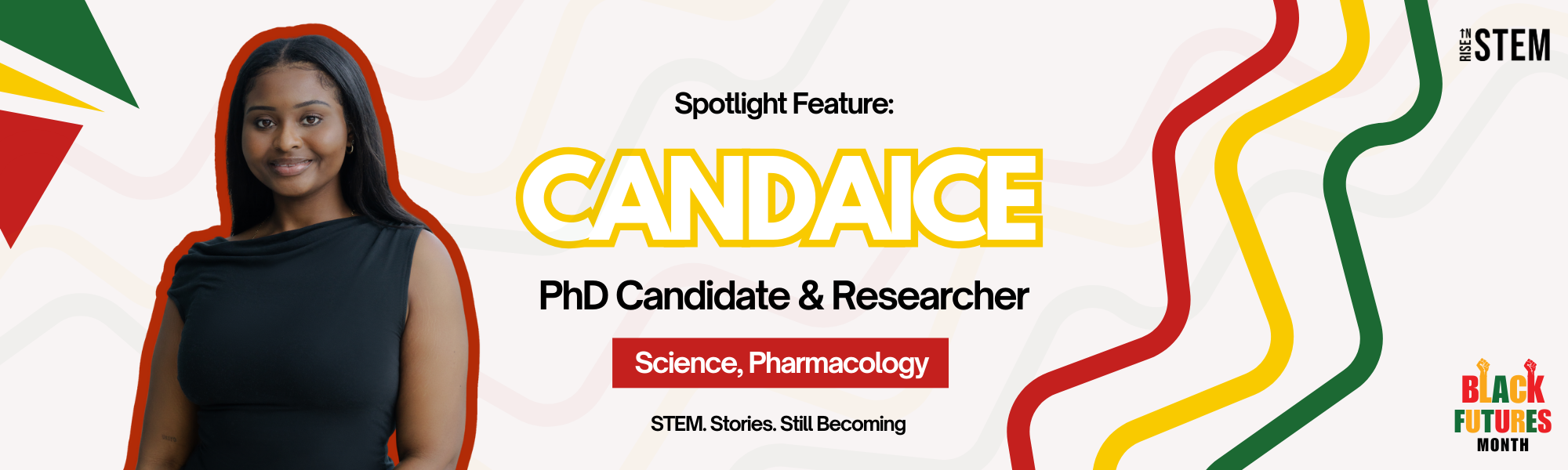
Designed by Chanelle Abankwah, Transforming Sights
Still Becoming Candaice
“I was always the child who asked ‘why.’ I’m sure it was very annoying to my parents, but I always had an inquisitive nature about the world around me.”
Curiosity was not something Candaice turned on and off. It was simply how she moved through the world. Asking questions became second nature. The world felt less like something to accept and more like something to investigate.
What started as childhood curiosity slowly became direction. Long before university lectures and laboratory benches, she often found herself watching the Discovery Channel for fun, drawn to documentaries that explored how the world works. That same instinct to ask why would later guide her through life sciences at McMaster University. Lecture halls sharpened her knowledge, but laboratories lit the spark. Lab-based courses became her favourite. Experiments felt familiar. As someone who loves to bake, she found the same rhythm in experiments that she finds in a kitchen: measuring, testing, adjusting, observing. The method felt both familiar and thrilling, watching ideas transform into results.
Her direction crystallized during a research course in cancer therapeutics. That experience, paired with her family history, made the work deeply personal. Science was no longer just fascinating. It was purposeful. Candaice wanted to pursue research and contribute to discoveries that could positively impact people’s lives. She chose to pursue a PhD in Pharmacology, where she now investigates novel therapeutic strategies for leukemia and explores the intricacies of stem cell biology. The questions she once asked as a child have evolved into research that could change lives.
But Candaice’s growth has not been confined to textbooks or pipettes.
One of her most significant lessons was not taught in a classroom. She learned that academic performance alone is not enough for success. Growing up hearing “knowledge is power” and that she had to be “twice as good,” she focused intensely on grades. Over time, she realized that competence, or earning good grades alone, does not guarantee success. Good grades are important, but they are not the only way to secure an internship, land a full-time job at your dream company, or build a successful career.
In today’s modern world, relationships matter. Communication matters. Community matters. Success, she learned, lives at the intersection of skill and connection. It matters who you know, not just what you know. Opportunities often come through people who believe in you, advocate for you, and open doors you did not know existed. The opportunities you yearn for require stepping beyond the comfort of solitary study and into spaces where mentorship, advocacy, and collaboration thrive. It is important not just to put your head down and study, but to actively participate in activities that interest you and take the initiative to engage with people who may have more life experience than you. Success stems from a combination of competence, communication, and connection.
Now in the final year of her PhD, Candaice stands in a space that makes her ponder which career path she wants to pursue while also working on her personal goals. She once believed she would have everything mapped out by 25. That timeline and those expectations created pressure. As she evolves personally and professionally, she is learning to enjoy the journey rather than simply checking items off a lengthy to-do list. Today, she holds a different perspective. Growth does not obey arbitrary deadlines.
“Still becoming” means honoring the years of discipline, late nights, and hard-earned knowledge, while allowing space for refinement and discovery in both her career and personal pursuits. It means recognizing that evolution is not a flaw in the plan. It is the plan.
As we reflect on Candaice’s journey, it is a clear reminder that becoming is not about arrival; it is about continuation and embracing each moment with gratitude. It may begin with a constant curiosity, asking why things behave or operate the way they do. That curiosity is the foundation of science. When nurtured, it can carry you from childhood questions to classrooms, laboratories, and beyond.
This is Candaice Newell, and this is her story of becoming.
